Best AI Certifications in 2026: The Career-Focused Guide
The AI hiring boom has completely rewritten the tech playbook. We have crossed the line separating speculative AI experimentation from hard-nosed, production-grade implementation. As traditional software roles face structural shifts, there has been an unprecedented explosion of AI Engineer roles, MLOps specialists, and Agent Engineers who can build self-correcting, autonomous systems.
Yet, for developers and data practitioners, this gold rush has created massive career confusion. Your LinkedIn feed is likely a non-stop parade of vendor badges, university micro-credentials, and open-source bootcamps. It raises a high-stakes question: which AI certifications are actually worth your time and money in 2026?
Most AI certificates are resume decorations that hiring managers ignore. However, a select group of proctored, platform-specific credentials act as powerful career accelerators. They help you clear automated resume filters, prove you can manage rising cloud compute costs, and demonstrate you can safely deploy autonomous systems into live enterprise environments. This guide cuts through the marketing noise to identify the credentials with maximum hiring ROI.
- A full comparison of 15 leading AI credentials ranked by hiring value and ROI
- Which certifications correlate with the highest salary ranges in 2026
- The recommended path for software engineers transitioning to AI roles
- How hiring managers actually use certifications to filter candidates
- A decision framework matching certifications to 7 specific career roles
- The 4 most common certification mistakes and how to avoid them
- AI Certification Comparison (2026)
- 2026 Hiring Trends
- Best Certifications by Salary Potential
- Best Certifications for Software Engineers
- What Hiring Managers Actually Look For
- Which Certification Should You Choose?
- Certification Learning Path: Beginner to Advanced
- Common Certification Mistakes in 2026
- FAQ
- What To Do Next
1. AI Certification Comparison (2026)
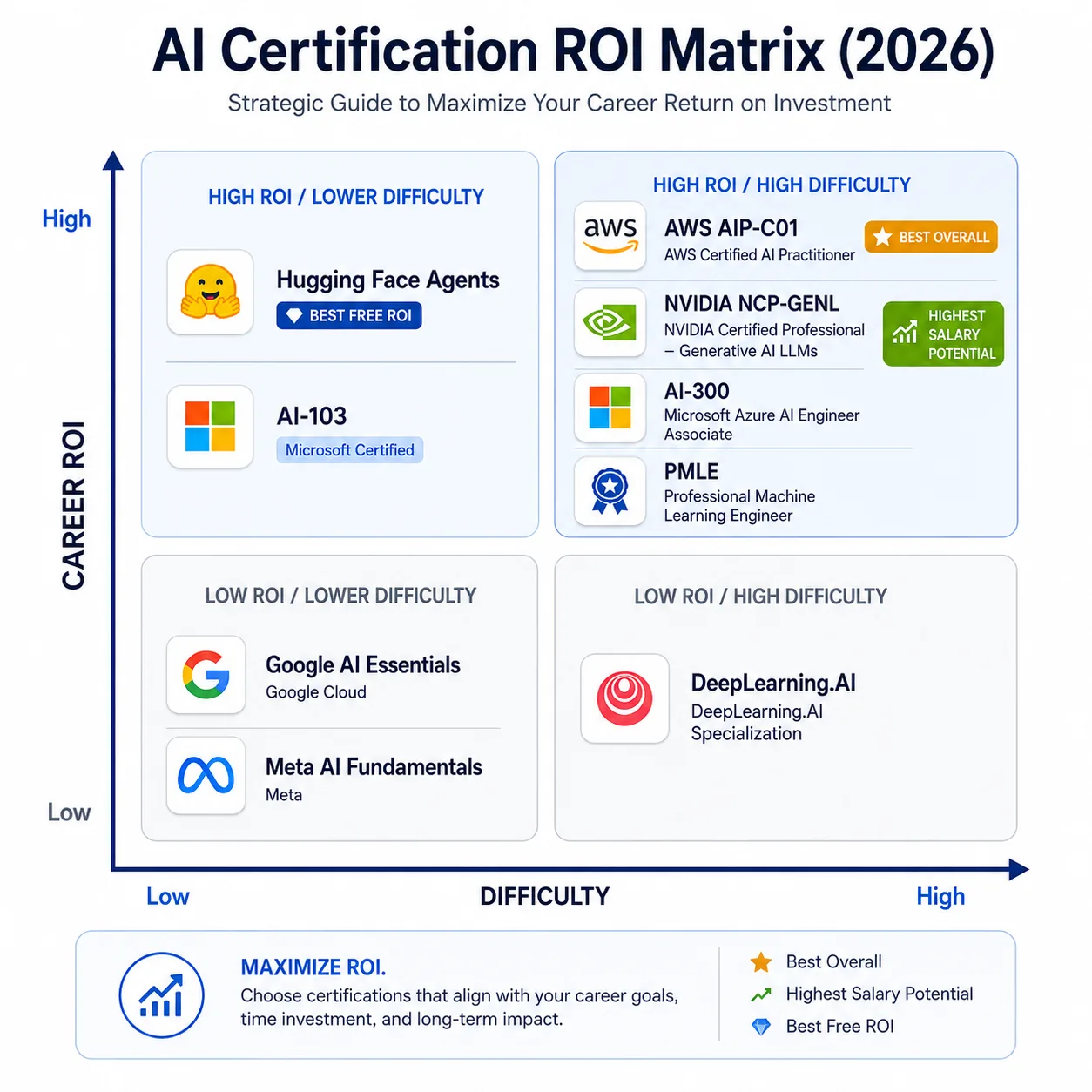
This master comparative matrix evaluates the market's leading credentials based on proctoring rigor, technical depth, and financial return. Use it as your primary baseline for an objective AI certification comparison before committing resources.
| Certification | Difficulty | Cost | Hiring Value | ROI | Best For |
|---|---|---|---|---|---|
| AWS GenAI Developer Pro (AIP-C01) | Advanced | $300 | 9.5 / 10 | 9.2 / 10 | Cloud Architects & Applied AI Engineers |
| NVIDIA Professional (NCP-GENL) | Extreme | $200 | 9.7 / 10 | 9.5 / 10 | Core ML & Systems Infrastructure Engineers |
| Microsoft Azure AI-103 | Intermediate+ | $165 | 8.9 / 10 | 9.0 / 10 | Full-Stack & Backend Application Developers |
| Google Cloud PMLE | Advanced | $200 | 9.1 / 10 | 8.8 / 10 | Production ML Engineers & Data Architects |
| Microsoft MLOps Associate (AI-300) | Advanced | $165 | 9.3 / 10 | 9.4 / 10 | MLOps Specialists & DevOps Engineers |
| Databricks GenAI Engineer | Intermediate+ | $200 | 8.7 / 10 | 8.9 / 10 | Data Platform Engineers & Analytics Architects |
| AWS ML Engineer Assoc (MLA-C01) | Intermediate | $150 | 8.2 / 10 | 8.5 / 10 | Mid-level Developers & Platform Builders |
| Hugging Face AI Agents | Intermediate | Free | 7.8 / 10 | 9.8 / 10 | Open-Source Builders & App Developers |
| DeepLearning.AI Specialization | Intermediate+ | $49/mth | 8.0 / 10 | 8.7 / 10 | Analytical Data Scientists & Researchers |
| Gemini for Developers | Intermediate | $49/mth | 7.9 / 10 | 8.5 / 10 | Full-Stack Developers & Prototypers |
| IBM AI Engineering | Beginner+ | $49/mth | 7.2 / 10 | 7.5 / 10 | Career Switchers & Tech Starters |
| AWS AI Practitioner (AIF-C01) | Beginner | $100 | 6.5 / 10 | 7.8 / 10 | Product Managers & Non-Technical Leaders |
| NVIDIA Associate (NCA-GENL) | Beginner+ | $125 | 6.8 / 10 | 7.2 / 10 | Aspiring Developers & Systems Analysts |
| Meta AI Fundamentals | Beginner | Free / $49 | 5.5 / 10 | 7.0 / 10 | Academic Students & Technical Beginners |
| Google AI Essentials | Beginner | $49 | 3.0 / 10 | 7.8 / 10 | Corporate Workforce & General Staff |
2. 2026 Hiring Trends
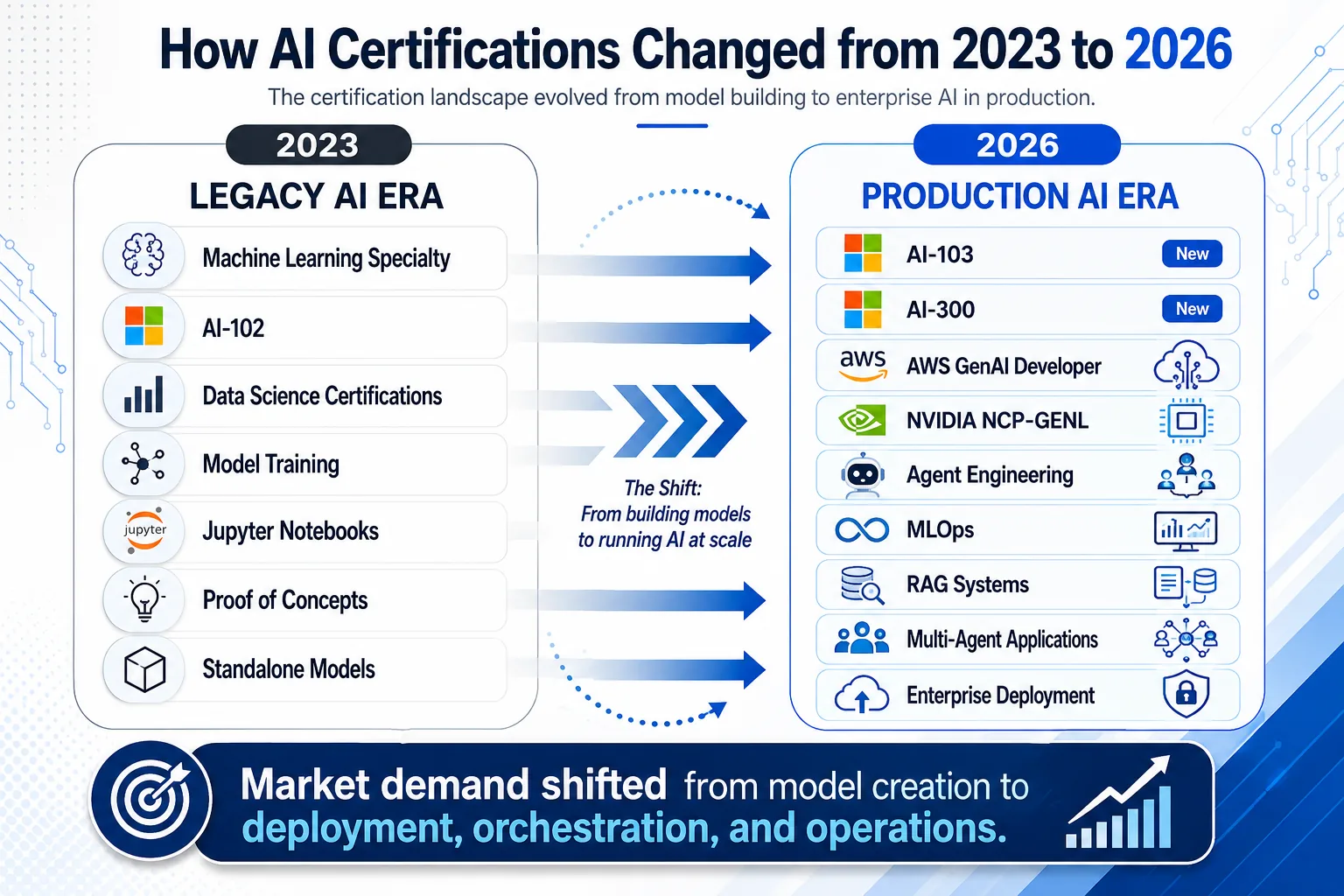
The AI engineering market is undergoing an aggressive structural shift. The era of the isolated Prompt Engineer typing natural language queries is officially over. In 2026, enterprise demand has fully migrated toward systems-level engineering, runtime reliability, and deterministic software wrappers around non-deterministic models.
| Past Paradigm | 2026 Enterprise Reality |
|---|---|
| Prompt Engineer | AI Engineer: API, Context & System Tuning |
| Chatbot Builder | Agent Developer: Stateful, Multi-Loop Design |
| Model Builder | MLOps Engineer: CI/CD, Monitoring, FinOps |
| AI Developer | AI Systems Architect: Enterprise Topology |
Hiring managers are no longer prioritising candidates who can merely train custom models in isolated local environments. They are seeking practitioners who can deploy, monitor, secure, and scale pre-trained systems within strict budget constraints.
Autonomous agentic systems capable of executing multi-step reasoning loops, accessing external databases, and self-correcting without human intervention are changing hiring requirements entirely. If your resume only highlights model discovery and high-level wrappers, you are competing for roles that are rapidly shrinking.
3. Best AI Certifications by Salary Potential
The salary delta in the modern technical landscape is driven entirely by systems-level optimisation, infrastructure automation, and autonomous workflow design. Targeting the highest-paying certifications is your most direct lever for maximising earning power.
| Certification | Typical Role | Salary Impact / Baseline Range |
|---|---|---|
| NVIDIA NCP-GENL | Hardware Optimisation Engineer / Core ML Lead | $140,000 to $250,000+ total compensation |
| AWS GenAI Developer Pro (AIP-C01) | Lead Generative Systems Architect | $140,000 to $184,000+ base salary |
| Microsoft MLOps Associate (AI-300) | Enterprise MLOps / Infrastructure Specialist | $135,000 to $180,000+ baseline |
| Google Cloud PMLE | Production ML Architect / Platform Specialist | $130,000 to $175,000+ regional range |
| Microsoft Azure AI-103 | Applied AI / Autonomous Agent Specialist | $135,000 to $170,000+ initial range |
The direct relationship between specialised systems engineering and premium compensation comes down to cloud economics. An engineer who merely builds applications using third-party APIs acts as a cost centre, consuming expensive tokens. An engineer with an NVIDIA NCP-GENL understands how to implement parameter-efficient fine-tuning, manage quantisation states (FP8/INT4), and configure high-throughput batching servers, skills that save enterprises millions in compute costs.
4. Best AI Certifications for Software Engineers
If you are a traditional software engineer who already understands Python, RESTful APIs, relational databases, and cloud infrastructure fundamentals, skip beginner-level literacy certifications entirely. Spending time on foundational credentials like Google AI Essentials or AWS AI Practitioner dilutes your profile and signals a lack of technical depth to recruiters.
The recommended engineering progression follows three steps:
5. What Hiring Managers Actually Look For
To understand where a certification fits in your job search, you must recognise how engineering leads filter candidates. No enterprise organisation will hire based on credentials alone. The recruitment pipeline uses a strict hierarchy:
- Deployed Production Portfolios: Live apps, clean repositories, systems logs
- Verified Industry Professional Cloud Experience
- Proctored Platform Certifications: AWS, Azure, GCP, NVIDIA
- Unproctored Course Completion Certificates
A robust portfolio featuring functional applications, cost-optimised vector storage setups, and documented GitHub repositories is what ultimately converts technical interviews. Certifications are the fuel that gets you into the room. High-quality platform credentials serve as an initial verification layer, help you bypass automated ATS systems, and demonstrate a structured approach to upskilling.
6. Which Certification Should You Choose?
Before investing your time and money, use this targeted decision framework to match your current background and career goals with the right credential.
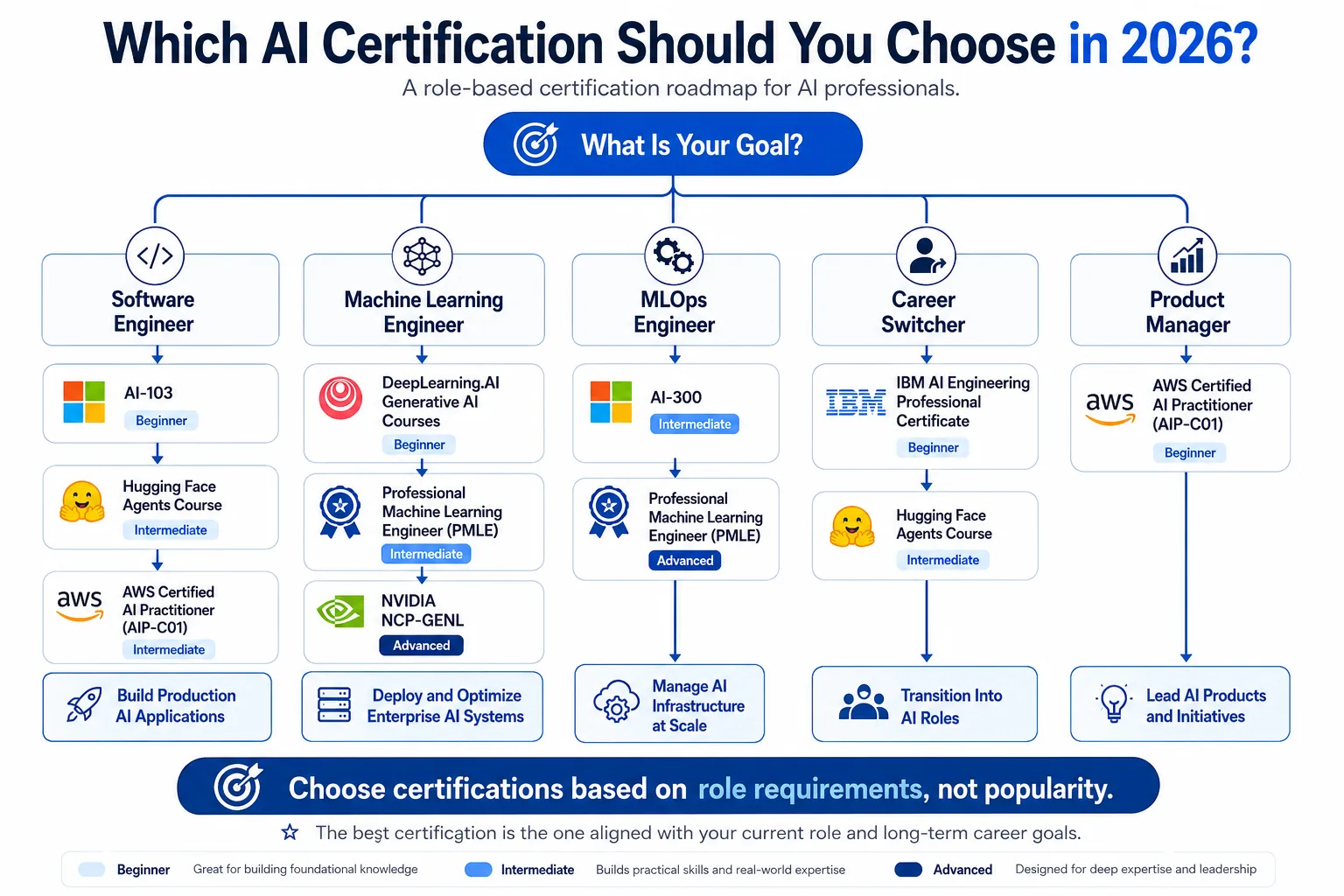
- Software Engineer / Backend Developer: Target Microsoft Azure AI-103 or AWS GenAI Professional (AIP-C01) to master the application runtime and orchestration layer.
- Generative AI Engineer: Target AWS AIP-C01 primary, Databricks GenAI Engineer secondary. Master data governance and vector optimisation before attempting the AWS exam.
- Machine Learning Engineer: Target NVIDIA NCP-GENL primary, Google Cloud PMLE secondary. Master deep learning theory via DeepLearning.AI first, then validate hardware expertise with NVIDIA.
- MLOps Engineer / DevOps Specialist: Target Microsoft AI-300 primary, Google Cloud PMLE secondary. Develop strong CI/CD skills before attempting the Azure exam.
- Data Scientist: Target DeepLearning.AI Deep Learning Specialization primary, IBM AI Engineering Professional Certificate secondary. Solidify statistics foundations before attempting neural network architecture courses.
- AI Architect: Target AWS AIP-C01 primary, Google Cloud PMLE secondary. Accumulate significant enterprise systems experience before attempting either advanced credential.
- Product Manager: Target AWS Certified AI Practitioner (AIF-C01) primary, Google AI Essentials secondary. Complete Google AI Essentials first to understand daily AI productivity tools, then study the AWS Practitioner curriculum for governance and compliance context.
7. Certification Learning Path: Beginner to Advanced
A structured, multi-phase progression prevents the common mistake of attempting advanced professional certifications without foundational knowledge.
8. Common Certification Mistakes in 2026
The technical landscape shifts so rapidly that exams frequently become outdated within 18 months. A major mistake is dedicating months of study to legacy credentials like Microsoft AI-102, DP-100, or AWS MLS-C01, all of which have been retired. Pivot to updated credentials: AI-103, AI-300, and MLA-C01 cover modern agentic orchestration and generative workloads.
Many candidates focus on model creation and ignore the mechanics of model deployment. Enterprise AI project failure rates remain high primarily due to poor infrastructure and deployment pipelines, not poor models. Overlooking tools like Kubernetes and Terraform, or failing to pursue the Microsoft AI-300, leaves a visible gap in your professional profile.
Racking up dozens of entry-level certificates without advancing to proctored, platform-specific credentials or building a public portfolio signals a lack of depth. Hiring managers overwhelmingly value one challenging, proctored certification such as the Google PMLE over a stack of basic theoretical certificates.
With increasing legislation around AI bias, data privacy, and algorithmic safety, candidates who can build models but cannot implement compliance guardrails, hallucination scanning, or strict data governance are exposed to severe deployment liabilities. The Databricks and AWS GenAI exams test these skills explicitly.
FAQ
Yes, provided they align with your current career stage and target role. For an investment of $165 to $300, professional platform certifications from AWS, Microsoft, and Google act as key ATS differentiators and help secure engineering roles commanding $120,000 to $250,000+ salaries. Subscription-based learning paths at $49 per month offer excellent ROI for building foundational knowledge before attempting the expensive exams.
Most major platform certifications from AWS, NVIDIA, Google Cloud, and Databricks enforce a validity period of two years. Microsoft role-based certifications require a free online renewal assessment annually to ensure the credential holder's skills remain current with the platform.
While a Computer Science degree remains relevant for Research Scientist roles, the global talent deficit has forced enterprises to hire based on demonstrable skills. For Applied AI Engineering, MLOps, and generative application development, a strong GitHub portfolio paired with professional-tier platform certifications can effectively bypass traditional degree requirements.
For non-technical professionals, Google AI Essentials at $49 and approximately 10 hours is an efficient starting point. For aspiring technical professionals planning to learn to code, the Meta Machine Learning Fundamentals or the AWS Certified AI Practitioner provide a solid runway without overwhelming technical depth.
Software engineers should skip beginner literacy badges entirely and start with Microsoft Azure AI-103, which teaches agentic system design using Semantic Kernel and AutoGen. Follow with the Hugging Face AI Agents Course for open-source mastery, then cap with the AWS GenAI Developer Professional (AIP-C01) to validate enterprise-grade generative system architecture.
The NVIDIA Certified Professional (NCP-GENL) correlates with the highest total compensation, targeting Hardware Optimisation Engineer and Core ML Lead roles at $140,000 to $250,000+ total compensation. The AWS GenAI Developer Professional (AIP-C01) comes second, with Lead Generative Systems Architect roles ranging from $140,000 to $184,000+ base salary.
Proctored certifications from AWS, NVIDIA, Microsoft, Google, and Databricks require a verified identity check and a monitored exam environment, making them credible to hiring managers and ATS systems. Unproctored course completion certificates can be obtained without identity verification, which is why hiring managers treat them as supplementary learning rather than standalone credentials.
One challenging proctored certification such as the Google Cloud PMLE or AWS AIP-C01 outweighs a stack of basic theoretical certificates on any resume. Certificate collection syndrome, accumulating many entry-level badges without building a portfolio or advancing to proctored credentials, is one of the most common mistakes that signals a lack of depth to engineering leads.
The AWS Certified AI Developer Professional (AIP-C01) is an advanced-level proctored exam costing $300 that validates the ability to architect secure, scalable, and audited generative AI systems on AWS infrastructure using tools like Amazon Bedrock. It has a hiring value of 9.5 out of 10 and is considered one of the strongest credentials for cloud architects and applied AI engineers in enterprise environments.
Several major certifications have been retired or replaced. Microsoft AI-102 and DP-100 have been superseded by AI-103 and AI-300. The AWS MLS-C01 has been replaced by the MLA-C01. Candidates should avoid investing study time in these legacy exams and pivot to the updated credentials that cover modern agentic orchestration and generative workloads.
9. What To Do Next
Navigating the tech ecosystem successfully requires turning insight into immediate execution. Your next step depends on your current background.
Do not buy expensive vendor vouchers yet. Focus on building baseline programmatic thinking. Begin with the IBM AI Engineering Professional Certificate to master basic Python, data manipulation, and classical frameworks. Once you can script comfortably, review our AI Engineer role guide to understand how to structure your transition.
Skip foundational literacy badges entirely. Pivot your backend programming capability into agentic orchestration. Enroll in the Microsoft Certified: Azure AI App and Agent Developer Associate (AI-103) track. Cross-reference your preparation with our complete AI Engineer Roadmap and start building on open-source agent frameworks immediately.
Bridge the gap between model training and systems delivery. Shift your focus toward operations by targeting the Microsoft Certified: Machine Learning Operations Engineer Associate (AI-300). Review our MLOps Engineer role guide to align your math skills with cloud architecture requirements.
Build public proof of your skills. Start by completing the free Hugging Face AI Agents Course. Use the practical assignments to build real, autonomous systems and publish your code to GitHub. Prepare for the recruitment pipeline by studying our curated AI Engineer role guide to master both system architecture and technical interview questions.
Related Role Guides
Interview Prep
Related Concepts to Study
Disclaimer: The views, rankings, and assessments in this article represent our editorial opinions based on publicly available information at the time of writing. Certification costs, availability, exam formats, and validity periods change frequently. Please visit the official provider websites (AWS, NVIDIA, Microsoft, Google, Databricks, Hugging Face, etc.) for the most up-to-date and accurate pricing and registration details before making any decisions.
Master AI/ML with AI Prep app
AI Prep covers AI Agents, Generative AI, ML Fundamentals, NLP & LLMs and a lot more, with adaptive tests and daily challenges. Fully offline on Android. Free to try, one-time unlock for lifetime access.