Engineering Memory: The Architecture of Modern Spaced Repetition and Vocabulary Systems
How the FSRS algorithm predicts memory decay, and how vocabulary apps engineer complete learning platforms around it for IELTS, TOEFL, GRE, GMAT, and CAT prep.
Millions of people attempt to learn a new language every year, and try to build a working vocabulary for exams like IELTS, TOEFL, GRE, GMAT, and CAT. The vast majority of them will forget almost everything they studied within a matter of months.
This failure is rarely a lack of effort or motivation. It is an engineering failure. Human memory operates on biological constraints that naturally discard information deemed irrelevant by the brain. When learners use static flashcards, arbitrary review schedules, or unstructured reading, they fight against the brain's natural forgetting curve rather than working alongside it.
This introduces a foundational engineering challenge: how can software determine the mathematically optimal moment to review a piece of vocabulary?
Recently, open-source algorithms have essentially solved this scheduling problem. However, calculating a review date is only one piece of the puzzle. Even if software perfectly answers the scheduling question, an equally important architectural question remains: how do we build an entire vocabulary-learning ecosystem around that scheduler, one that actually holds up for exam prep and everyday fluency alike?
This article explores the cognitive science of human memory, dissects the mathematics of the Free Spaced Repetition Scheduler (FSRS 4.5), and examines how modern vocabulary platforms engineer comprehensive learning architectures around these algorithms, for IELTS, TOEFL, GRE, GMAT, CAT, and permanent language acquisition alike.
- Why the forgetting curve makes cramming vocabulary lists almost worthless long-term
- How scheduling algorithms evolved from paper flashcards to machine-learned FSRS 4.5
- The DSR (Difficulty, Stability, Retrievability) math that actually powers FSRS
- Why FSRS beats the old SM-2 algorithm most vocabulary and flashcard apps still use
- What a scheduler intentionally does not solve, and why exam vocabulary needs more
- How a real platform (LangBlitz) engineers curriculum, quizzing, visualization, accessibility, and exam-relevance tagging around FSRS
IELTS, TOEFL, GRE, GMAT, and CAT vocabulary prep all share the same underlying constraint: a large, fixed set of words that must be recalled reliably, months after first exposure, under time pressure. That is exactly the problem spaced repetition was built to solve. The algorithm doesn't care whether a word is "abate" for the GRE or "ubiquitous" for everyday reading. What changes for exam prep is how the content around the word is organized and tagged, not the scheduling math underneath it.
- The Cognitive Science of Human Memory
- The Evolution of Scheduling Algorithms
- Understanding FSRS 4.5: The DSR Memory Model
- Calculating the Optimal Interval
- Why FSRS Surpasses SM-2
- The Boundaries of FSRS: What Scheduling Intentionally Ignores
- Engineering a Complete Vocabulary Learning Platform
- Looking Ahead
- FAQ
1. The Cognitive Science of Human Memory
To build software that schedules memory, we must first define how memory decays.
The empirical investigation into human memory began in 1885 with German psychologist Hermann Ebbinghaus. Through rigorous self-experimentation, Ebbinghaus demonstrated that the decay of human memory is not linear. Information is lost rapidly immediately after learning, followed by a gradual leveling off, a mathematical reality known as the Forgetting Curve.
Cognitive psychology has since identified specific mechanisms that drive memory consolidation, which modern software must replicate:
- The Spacing Effect: Spreading learning sessions across multiple days yields significantly higher long-term retention than massing the same number of repetitions into a single cramming session.
- The Testing Effect (Active Recall): The active retrieval of information from memory modifies neural pathways, strengthening the memory trace far more effectively than passive restudy. Active recall forces the brain to reconstruct knowledge, creating durable synaptic connections.
- Desirable Difficulty: To maximize the strengthening of a memory trace, a learner must be forced to recall the information at the exact moment it is on the verge of being forgotten. Intervening too early wastes time and provides minimal cognitive benefit. Intervening too late results in a lapse, requiring the material to be relearned entirely.
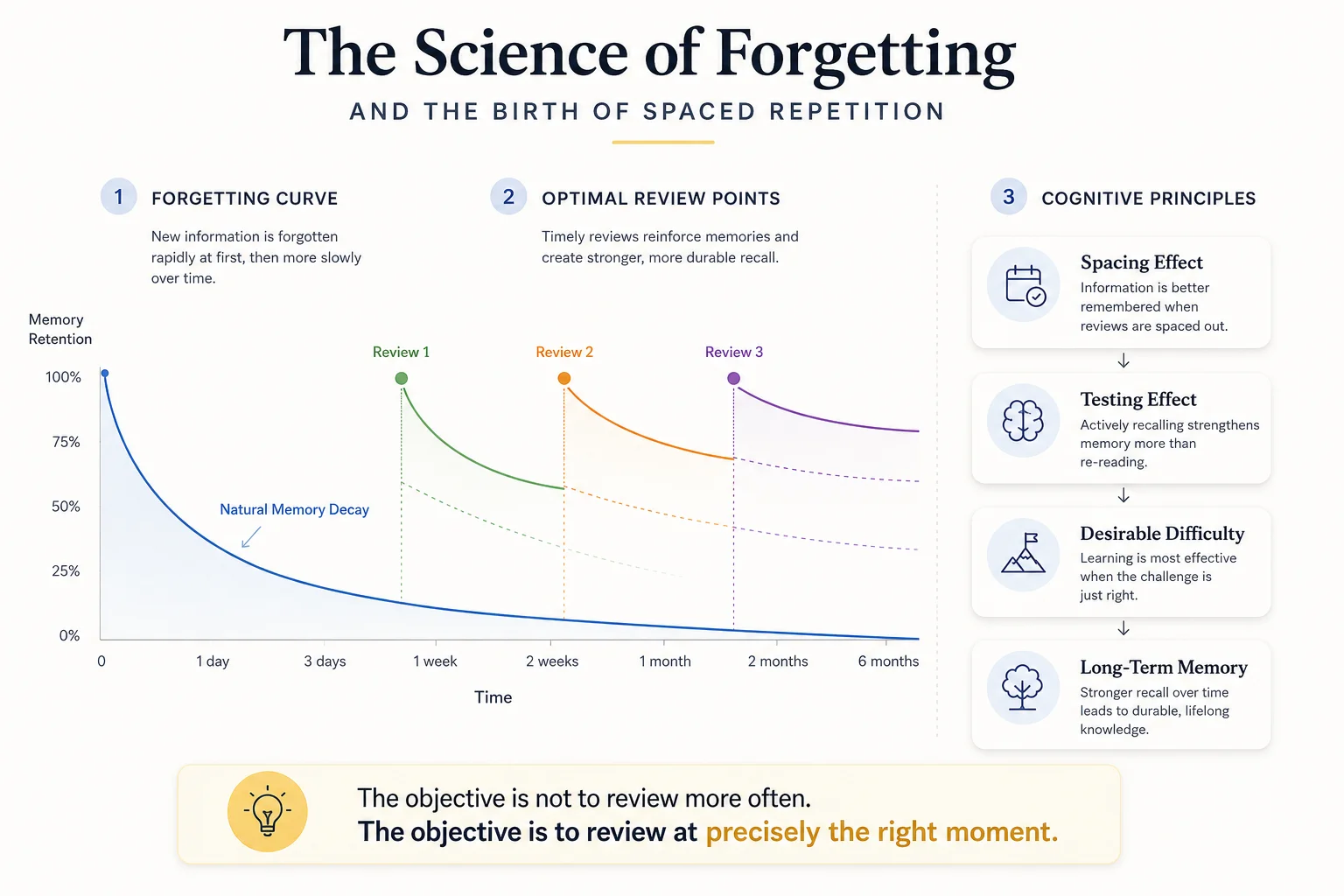
The objective is not to review more often. The objective is to review at precisely the right moment: the point where a word is about to be forgotten but hasn't been yet.
2. The Evolution of Scheduling Algorithms
Translating spaced repetition from an abstract cognitive principle into a practical computational algorithm has undergone a decades-long evolution.
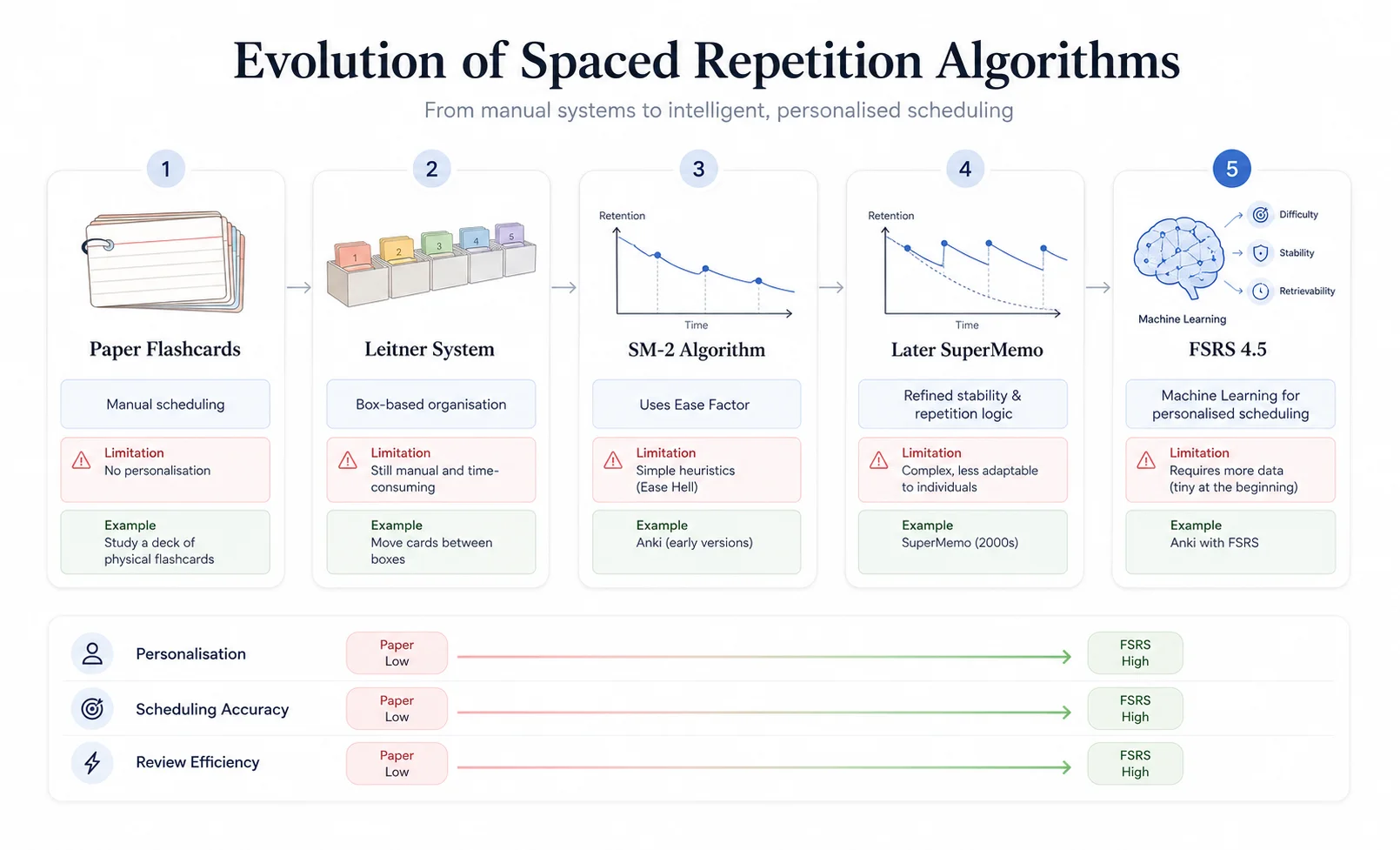
| Method | Era | How It Works | Key Limitation |
|---|---|---|---|
| Paper Flashcards | N/A | Manual review, ordered entirely by learner intuition | No personalization; doesn't scale beyond a small deck |
| Leitner System | 1970s | Five physical boxes; cards graduate to longer intervals on success, reset to Box 1 on failure | Still manual and time-consuming; no granular difficulty tracking |
| SuperMemo SM-2 | 1987 | A per-card Easiness Factor multiplies the interval on every successful review | "Ease hell": difficult cards get trapped at a permanent interval floor |
| Later SuperMemo (SM-4–SM-18) | 1989–2019 | Matrices of optimal factors and absolute difficulty factors | Highly advanced but proprietary, closed-source, hard to reverse-engineer |
| FSRS 4.5 | 2022+ | A 17-parameter DSR (Difficulty, Stability, Retrievability) model trained via gradient descent on your own review history | Needs more review data early on, but self-corrects quickly and stays open-source |
The core assumption of early algorithms like SM-2 was that a single scaling factor could simultaneously represent a card's inherent difficulty and its optimal interval growth rate. This mathematical conflation forced the algorithm into edge cases where difficult cards became trapped in an asymptotic loop of short intervals, creating unsustainable review loads.
FSRS was conceptualized by Jarrett Ye (known online as L-M-Sherlock) while analyzing 220 million review logs at MaiMemo, a large Chinese language-learning platform. That analysis was formalized in "A Stochastic Shortest Path Algorithm for Optimizing Spaced Repetition Scheduling" (Ye, Su & Cao, ACM SIGKDD 2022), which reported a 12.6% performance improvement over prior scheduling methods. That scale of data exposed exactly where SM-2 broke down: it applied identical interval multipliers to every user, ignoring that people have very different baseline forgetting rates. Ye open-sourced a generalized version of the resulting model in late 2022, and the results were compelling enough that Anki's maintainer integrated FSRS natively into the app in version 23.10 (October 2023), making it the new default standard for spaced repetition software.
The evolution toward FSRS was driven by the necessity to decouple difficulty from interval growth, and to treat memory as a multi-dimensional, personalized state rather than a single global constant.
3. Understanding FSRS 4.5: The DSR Memory Model
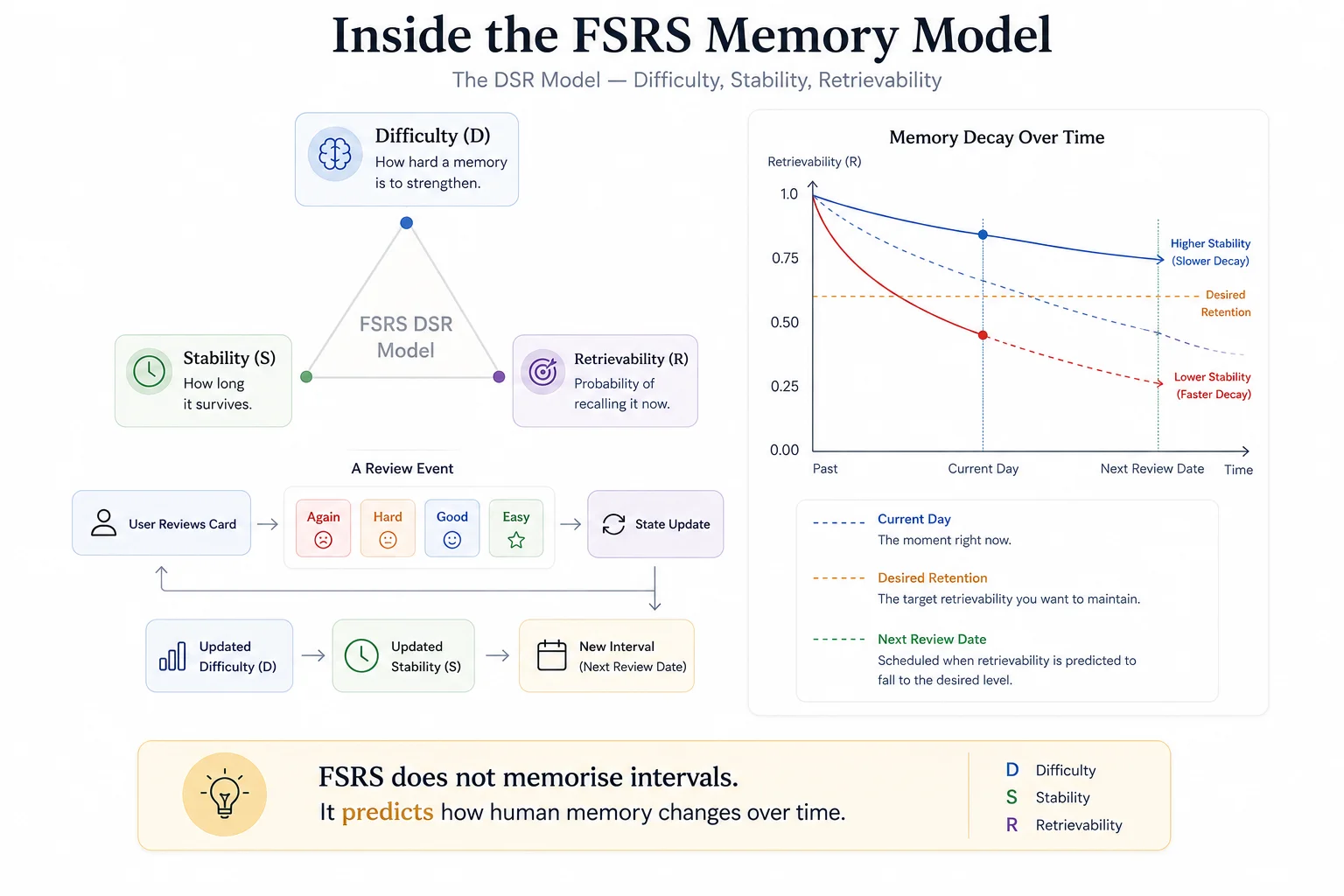
The core logic of FSRS 4.5 is a computational embodiment of the Two-Component Model of Memory. This cognitive model asserts that memory is not a single scalar value, but a vector comprising two independent variables: storage strength and retrieval strength.
FSRS maps this theory directly into its internal DSR (Difficulty, Stability, Retrievability) architecture.
1. Retrievability (R)
Retrievability is the algorithmic equivalent of retrieval strength. It represents the exact probability of successful recall at the current moment.
Unlike early models that incorrectly assumed an exponential forgetting curve, large-scale dataset analysis proved that human forgetting is better approximated by a power-law function. The probability of recall R after t days is calculated as:
For FSRS 4.5, and .
The Intuition: This power-law formulation guarantees that when the elapsed time t exactly equals the item's Stability S, the probability of recall evaluates to exactly 0.9 (90%). The curve drops sharply in the early days but flattens out into a long tail, accurately representing how older, remote memories persist over time.
2. Stability (S)
Stability is the algorithmic equivalent of storage strength. FSRS defines Stability precisely as the time, in days, required for Retrievability to decay from 100% to exactly 90%. A higher stability implies a significantly slower memory decay rate. Stability only changes when a memory is actively retrieved or forgotten.
3. Difficulty (D)
Difficulty is an inherent property of the knowledge chunk itself. It measures the resistance of the memory to increases in Stability. A highly difficult item (a rare, abstract GRE word, for example) will see much smaller gains in Stability after a successful review compared to a simple, familiar word.
4. Calculating the Optimal Interval
FSRS separates itself from legacy heuristics by tying its scheduling engine directly to human goals. The scheduler determines the next review interval I by taking the Retrievability equation, solving for t, and replacing R with the user's Desired Retention r:
The Intuition: Desired retention is the core control lever for the learner. If the user demands a 90% retention rate (r = 0.9), the math cleanly simplifies, and the equation outputs I = S. If the user demands a stricter 95% retention rate, closer to what an exam-prep learner might want, the interval is strictly compressed, resulting in far more frequent reviews. This direct conversion of cognitive goals into algorithmic schedules allows software to generate precise daily workloads.
The State Machine and Updates
Applications interact with the FSRS API via a state machine: New, Learning, Review, and Relearning. FSRS scheduling logic operates strictly over cards that have graduated into the long-term Review state.
When a card in the Review state is successfully recalled (graded as Hard, Good, or Easy), the new Stability is derived by multiplying the current Stability by a highly tuned Increase Factor. While dense, this equation perfectly encapsulates cognitive science into code:
- Difficulty Penalty: As Difficulty approaches its maximum, this term shrinks. Difficult material stabilizes extremely slowly, requiring more repetitions.
- Stabilization Decay: A negative exponent applies diminishing returns. The higher the existing Stability, the harder it is to increase it further, reflecting the asymptotic nature of long-term memory formation.
- The Spacing Effect: This is the crown jewel of the algorithm. As Retrievability drops toward zero (indicating an overdue review), this multiplier explodes exponentially. FSRS mathematically rewards the learner massively for recalling near-forgotten material, turning missed days into high-efficiency consolidation events rather than algorithm-breaking errors.
FSRS does not memorize intervals. It predicts how your individual memory changes over time, and recalculates the review date every single time you touch a card.
5. Why FSRS Surpasses SM-2
The rapid displacement of SM-2 by FSRS as the industry standard was driven by fundamental architectural differences.
Eliminating "Ease Hell"
In SM-2, grading a card "Hard" permanently penalized the scheduling multiplier to a floor of 1.3. FSRS utilizes mean reversion instead. A "Hard" rating is mathematically treated as a success; it temporarily increases difficulty, but over subsequent successful reviews, the difficulty slowly regresses toward a baseline. This prevents the review spirals that make struggling learners give up on hard vocabulary entirely.
Machine Learning Personalization
SM-2 uses rigid global constants, applied identically to every user. FSRS uses gradient descent to optimize its 17 parameters against your specific review history, minimizing log loss to create a memory model personalized to you, not an average user.
Workload Efficiency
By calculating exact probabilities of recall rather than relying on heuristic multipliers, an optimized FSRS schedule yields a 20% to 30% reduction in daily review volume while achieving the exact same target retention rate. For an exam-prep learner juggling a study schedule, that's the difference between a sustainable daily habit and a review queue that spirals out of control.
6. The Boundaries of FSRS: What Scheduling Intentionally Ignores
FSRS is a masterpiece of scheduling logic, but it is fundamentally just a microservice. It solves exactly one exceptionally difficult mathematical problem: when should a learner review a specific item?
FSRS intentionally does not solve application-level responsibilities:
- It operates under contextual and semantic isolation; it views every flashcard as an independent quantum of information, completely ignorant of how learning one word influences the recall of another.
- It assumes content formulation is perfect, lacking the ability to diagnose if a card is poorly designed.
- It does not understand curriculum design, exam relevance, user onboarding, or motivation.
7. Engineering a Complete Vocabulary Learning Platform
A modern learning platform requires multiple cooperating systems. The scheduler dictates the timing, but surrounding architectural layers must manage pedagogy, assessment, visualization, accessibility, and content depth.
We can observe how these layers are engineered in practice by examining LangBlitz, a modern vocabulary platform built around the FSRS core, with exam relevance tagging for IELTS, TOEFL, GRE, GMAT, and CAT built directly into its content model.
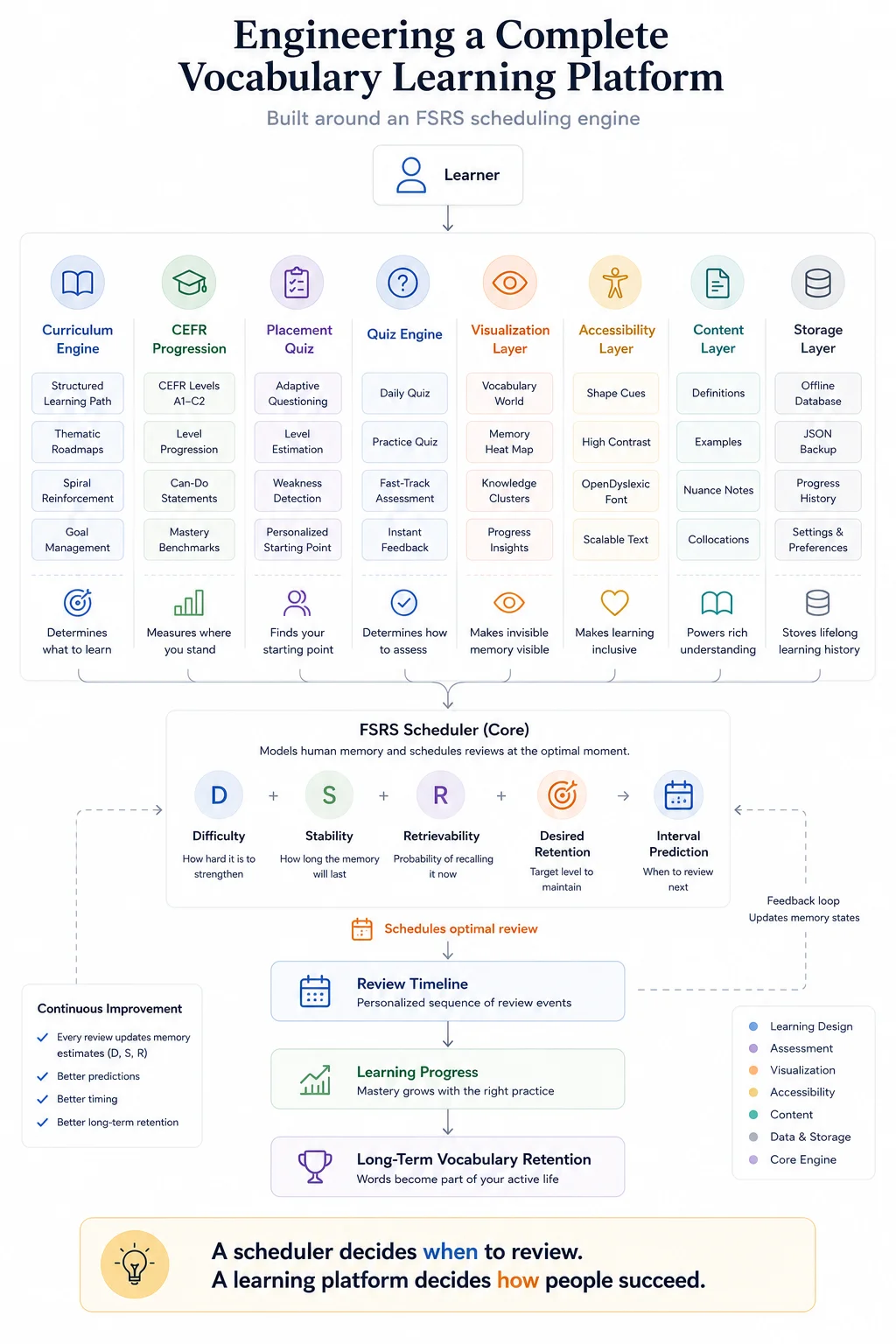
A scheduler decides when to review. A learning platform decides how people succeed: curriculum, assessment, visualization, accessibility, content depth, and data ownership all have to be engineered around the scheduler, not left out of it.
8. Looking Ahead
While the integration of FSRS represents the current state-of-the-art, the intersection of software engineering and cognitive science continues to evolve rapidly.
- AI-Assisted Initialization: Currently, a word's initial Difficulty parameter is a guessing game until the learner completes their first review. Future architectures will likely leverage large language models to semantically analyze a word's intrinsic complexity and assign a pre-calculated starting Difficulty instantly, optimizing the very first spacing interval.
- Adaptive Memory Decay Models: Cognitive scientists continue to debate the exact mathematical shape of human forgetting. Experimental parameters in newer FSRS versions are beginning to allow the decay curve itself to adapt individually to each user, moving closer to a biologically perfect simulation of the brain.
Conclusion
The evolution from static paper flashcards to the Free Spaced Repetition Scheduler is a triumph of computational cognitive science. FSRS represents one of the most mathematically sophisticated scheduling algorithms ever built, capable of predicting human memory decay with breathtaking accuracy.
However, an algorithm alone does not guarantee learning.
Great educational software requires recognizing where mathematics ends and human experience begins. As demonstrated by platforms like LangBlitz, successful vocabulary acquisition systems, whether the goal is an IELTS band score or lifelong fluency, emerge only when a pristine scheduling engine is surrounded by thoughtful software architecture: robust curriculum design, independent assessment, spatial data visualization, deep contextual content, and foundational accessibility.
FAQ
FSRS is an open-source spaced repetition algorithm that predicts how likely you are to remember a specific piece of information at any given moment, and schedules your next review for the point where that probability drops to a target you choose. It models memory using three variables (Difficulty, Stability, and Retrievability), trained on your own review history rather than relying on fixed, one-size-fits-all rules.
SM-2 uses a single global Easiness Factor per card, which conflates difficulty with interval growth and traps hard cards in permanently short intervals, an effect known as ease hell. FSRS separates difficulty and stability into independent variables and uses gradient descent to fit 17 parameters to your personal review data, which typically cuts daily review volume by 20% to 30% while hitting the same target retention.
Yes. Exam vocabulary is a textbook use case for spaced repetition: a large, fixed set of words that need to be recalled reliably under time pressure, months after first exposure. The forgetting curve applies regardless of why you're learning a word, so scheduling reviews at the point of desirable difficulty works exactly the same for GRE word lists as it does for everyday vocabulary. The difference is in how the words are tagged and organized for exam relevance, not the underlying algorithm.
The forgetting curve, first documented by Hermann Ebbinghaus in 1885, describes how memory decays rapidly right after learning and then levels off over time. It matters for vocabulary learning because it explains why cramming a word list once produces almost no long-term retention: without a review scheduled near the point of forgetting, the word simply falls off the curve and has to be relearned from scratch.
Desired retention is the target recall probability you want FSRS to maintain, typically set between 80% and 95%. A higher desired retention produces more frequent, shorter review intervals, which suits high-stakes exam prep where a forgotten word during the test has a real cost. A lower desired retention reduces daily workload and is more appropriate for casual, long-horizon vocabulary building.
No, generally the opposite. Because FSRS calculates the exact probability of recall instead of applying a blunt heuristic multiplier, users typically see a 20% to 30% reduction in daily review volume compared to SM-2 while maintaining the same retention rate, since it stops over-reviewing material you already know well.
Spaced repetition only solves the scheduling problem: when to review a specific item. It says nothing about curriculum ordering, whether a card is well-formed, or how to test comprehension beyond self-graded recall. Durable vocabulary acquisition also needs a placement and progression system, independent quizzing, rich word cards with usage context, and a way to make decay visible, which is why complete platforms layer additional systems around the scheduler rather than shipping the scheduler alone.
LangBlitz uses FSRS 4.5 as its core scheduling engine, wrapped in a CEFR-leveled curriculum (A1 to C2), a 15-question placement quiz, independent daily and practice quizzes, a 3D visualization of retrievability across 119 topic groups, and rich word cards with definitions, nuance, collocations, and exam relevance tags for IELTS, TOEFL, GRE, GMAT, and CAT. It works fully offline with no account required.
Master English vocabulary with LangBlitz app
LangBlitz uses FSRS spaced repetition to help you master 5,000+ curated words across 119 topic groups, with exam relevance tags for IELTS, TOEFL, GRE, GMAT, and CAT. Fully offline on Android. Free to try, premium unlocks the full library.